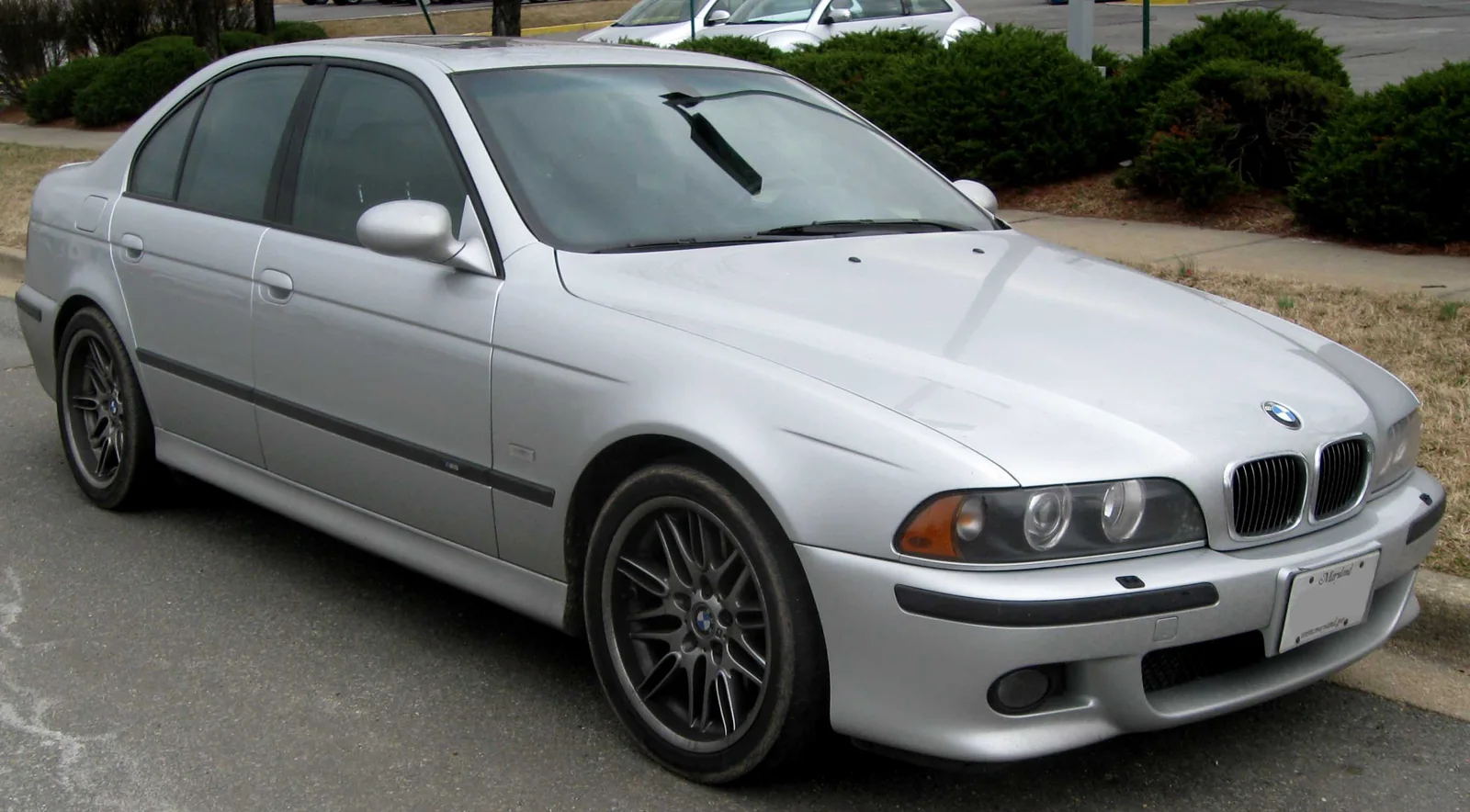
BMW E39 M5
UK MOT + US NHTSA · Reviewed · MethodologyUK roadworthiness data and US recall records · Great Britain MOT 2023; US NHTSA full-file snapshot 2026-10-29; UK DfT stock 2025 · Reviewed by Responsable del proyecto (usuario de esta conversación; nombre personal no facilitado) on 2026-10-29 · Sources and methodology
At a glance
- First-presentation pass rate
- 81.9%n = 796 initial tests
- Initial tests
- 796UK MOT 2023
- Engine
- S62 · 5.0L V8Technical source in the engine section
- Years
- US production began: September 1999Production and US model years can differ
- DVSA anonymised MOT tests and results · Retrieved 2026-10-29T05:26:14Z · Open Government Licence v3.0 · BMW M5; cc=4941-4941; first_use_year=1998-2004; provisional cohort, not VIN verified; ambiguous F10/F90 2017 excluded
The E39 M5 is the V8-and-manual chapter in this group of M5 generations. Its specification provides a clear contrast with the V10 E60 and turbocharged F10, but does not establish the condition of a car today. This guide keeps the US rating distinct from global figures, highlights current air-bag guidance and explains where common maintenance claims still lack verified primary evidence. It is a documentary guide based on published records; initial human editorial review is complete, while
Is the E39 M5 reliable?
No data: this project has not established a representative engine, transmission or total-repair failure rate for the E39 M5. The age or reputation of a generation cannot fill that gap. Neither can a clean safety-recall search certify its present mechanical condition.
For a useful assessment, organize the records by the system inspected and the work actually completed. Ask the inspector to relate each material finding to the car in front of them. If the seller says a major job has been done, seek a dated, itemized record and ask whether the present condition has been checked since. Our provisional conclusion is to treat the manual V8 layout as a reason to investigate this generation, while leaving the condition judgment to evidence from the individual car.
- NHTSA: Resources Related to Investigations and Recalls · Retrieved 2026-10-28 · NHTSA US government webpage; factual paraphrase. · Complaints do not provide a fleet exposure denominator or a measured failure probability.
Documented safety issues and repair questions
The safety item below is documented. The other topics remain questions for inspection and further research rather than a supported ranking of common failures.
Takata driver air-bag guidance
NHTSA's current Do Not Drive warning includes certain E39 M5 vehicles. Check the VIN and follow the current official instruction for that car. An older owner letter or a model-year match should not override a current VIN-specific finding.
- NHTSA: Critical Do Not Drive Warning for Certain Vehicles with Takata Air Bags · Retrieved 2026-10-28 · NHTSA US government webpage; short factual paraphrase only. · Certain vehicles only; no reader VIN was checked in this project. Safety notice must be rechecked before release.
- NHTSA acknowledgement: Recall 15V-318, driver frontal air-bag inflator · Retrieved 2026-10-28 · NHTSA federal acknowledgement; US government material, factual paraphrase. · Historical document; current VIN guidance takes priority. Aggregate affected population includes many models.
VANOS claims
No data: an official defect document establishing an E39 M5 VANOS fault population or a preventive replacement rule was not retrieved for this guide. We do not convert the existence of engine-control components into evidence of a universal defect. Ask an inspector to identify the basis of any diagnosis and the scope of previous work.
- BMW USA: The Third Generation BMW M5 E39, V8 Power for the Executive Express · Retrieved 2026-10-28 · BMW copyrighted historical text; short factual paraphrase only. · Retrospective manufacturer account; production totals deliberately not reproduced because counts are outside this content dataset.
Timing-system work
No data: the primary material assembled here does not establish a timing-system failure interval or the share of S62 engines requiring a particular repair. Request precise invoices if work is claimed. A broad timing done description leaves open which parts were examined or replaced and why.
- BMW USA: The Third Generation BMW M5 E39, V8 Power for the Executive Express · Retrieved 2026-10-28 · BMW copyrighted historical text; short factual paraphrase only. · Retrospective manufacturer account; production totals deliberately not reproduced because counts are outside this content dataset.
Cooling, leaks and chassis condition
No data: this guide has no accepted official dataset ranking these repair categories for E39 M5s. They remain sensible subjects to agree with an inspector, with findings recorded as observations about the specific vehicle. A category on an inspection checklist is not a claim that all examples share a known defect.
- BMW USA: The Third Generation BMW M5 E39, V8 Power for the Executive Express · Retrieved 2026-10-28 · BMW copyrighted historical text; short factual paraphrase only. · Retrospective manufacturer account; production totals deliberately not reproduced because counts are outside this content dataset.
- NHTSA acknowledgement: Recall 15V-318, driver frontal air-bag inflator · Retrieved 2026-10-28 · NHTSA federal acknowledgement; US government material, factual paraphrase. · Historical document; current VIN guidance takes priority. Aggregate affected population includes many models.
What to check before buying
Arrange the assessment around documentation and observable condition. A transmission preference should not distract from the quality of the body, maintenance evidence or unresolved safety guidance. Ask for a written list of limitations as well as findings.
- Verify the VIN and current applicable safety instructions before a road demonstration.
- Match the build information, engine identity and manual transmission to the records.
- Request itemized evidence for any VANOS, timing-system, cooling or structural work claimed.
- Have an inspector document warnings, stored faults, leaks, body condition and the fitted equipment.
- Separate confirmed work from seller statements, and list any areas that the inspection could not assess.
- NHTSA: Check for Recalls · Retrieved 2026-10-28 · NHTSA US government webpage; factual paraphrase. · Dynamic service; no live VIN query was performed.
- BMW USA: The Third Generation BMW M5 E39, V8 Power for the Executive Express · Retrieved 2026-10-28 · BMW copyrighted historical text; short factual paraphrase only. · Retrospective manufacturer account; production totals deliberately not reproduced because counts are outside this content dataset.
US model context and generation dates
BMW's US historical account says production of US cars began in September 1999 and E39 M5 production ended in June 2003. Those are production milestones; they should not silently become a calendar-year equipment guarantee.
No data: a verified annual US feature-change table is not included. If a particular lighting, cabin or control feature matters, identify it on the car and confirm it against build-specific documentation. Treat retrofits and original equipment separately.
- BMW USA: The Third Generation BMW M5 E39, V8 Power for the Executive Express · Retrieved 2026-10-28 · BMW copyrighted historical text; short factual paraphrase only. · Retrospective manufacturer account; production totals deliberately not reproduced because counts are outside this content dataset.
Engine and transmission: S62 V8 and six-speed manual
BMW identifies the E39 M5 engine as the S62 and its manual gearbox as the Getrag 420G six-speed. Its US historical specification gives 394 hp and 368 lb-ft from the naturally aspirated 5.0-liter V8. Global descriptions using 400 hp should retain their own market and rating context.
This pairing is the factual basis for the E39's distinct place in the comparison. Whether it feels preferable to an E60 is a human judgment this project has not tested. The engine code also matters when checking a technical claim: a document about another 5 Series engine cannot be assumed to describe the S62.
- BMW USA: The Third Generation BMW M5 E39, V8 Power for the Executive Express · Retrieved 2026-10-28 · BMW copyrighted historical text; short factual paraphrase only. · Retrospective manufacturer account; production totals deliberately not reproduced because counts are outside this content dataset.
- BMW USA: The 2020 BMW M5 Edition 35 Years, historical generations · Retrieved 2026-10-28 · BMW copyrighted press material; limited factual synthesis only. · Its retrospective date headings are not treated as a complete US model-year table; local dates are checked against contemporary launch sources.
Recall history and current VIN status
Treat historical campaign records as leads for a vehicle-specific check. Confirm applicable safety guidance and completed work with the manufacturer. Older campaigns can require records beyond a current online result.
| Complaint coverage | Recall coverage | Queried model years | Owner reports | Unique campaigns | Vehicle denominator |
|---|---|---|---|---|---|
| Complete for requested model-year scope | Complete for requested model-year scope | 2000;2001;2002;2003 | 17 | 5 | No data |
No data means the stated scope is unavailable, incomplete or has no vehicle denominator; it never means zero. Report totals and details are shown only for complete requested coverage for the respective dataset. Counts are not vehicle-level failure probabilities.
- NHTSA official datasets and APIs · Retrieved 2026-10-29 · US federal government public data; NHTSA
| Campaign | Queried model years | Report date | Component | Summary |
|---|---|---|---|---|
| 00V048000 | 2000 | 20000217 | EXTERIOR LIGHTING:BRAKE LIGHTS:SWITCH | VEHICLE DESCRIPTION: PASSENGER VEHICLES. THE BRAKE LAMPS IN THESE VEHICLES ARE CONTROLLED BY A SWITCH ACTIVATED BY THE MOVEMENT OF THE BRAKE PEDAL. THIS SWITCH COULD FAIL INTERNALLY, CAUSING IT TO REMAIN EITHER IN THE "BRAKE LAMPS OFF" POSITION OR IN THE "BRAKE LAMPS ON" POSITION. |
| 01V001000 | 2000;2001 | 20010104 | TIRES:SIDEWALL | VEHICLE DESCRIPTION: PASSENGER VEHICLES EQUIPPED WITH 18-INCH TIRES. (18-INCH TIRES ARE STANDARD EQUIPMENT ON THE M5 AND OPTIONAL EQUIPMENT ON THE 7-SERIES MODELS). THE MACHINE USED TO MOUNT AND INFLATE THE TIRES ON THE WHEELS AT THE ASSEMBLY PLANT MAY HAVE DAMAGED THE SIDEWALL OF ONE OR MORE TIRES. THE DAMAGED AREA COULD WEAKEN TO THE POINT WHERE A SUDDEN LOSS OF AIR FROM THE TIRE COULD OCCUR. |
| 03V421000 | 2001 | 20031024 | AIR BAGS:FRONTAL:SENSOR/CONTROL MODULE-INACTIVE | ON CERTAIN PASSENGER VEHICLES, A MICROPROCESSOR IN THE AIR BAG CONTROL MODULE, WHICH ACTIVATES THE FRONT AIR BAGS, THE SIDE AIR BAGS, THE FRONT SEAT SAFETY BELT PRETENSIONERS, AND THE BATTERY SAFETY TERMINAL, MAY HAVE A MALFUNCTION THAT COULD LEAD TO AN UNINTENDED ACTIVATION OF ONE OR MORE OF THESE COMPONENTS. |
| 15V318000 | 2002;2003 | 20150528 | AIR BAGS:FRONTAL:DRIVER SIDE:INFLATOR MODULE | BMW of North America, LLC (BMW) is recalling certain model year 2002-2005 325i, 325xi, 330i, and 330xi Sedans, and 325xi and 325i Sportswagons, 2002-2006 330Ci, 325Ci, and M3 Convertibles and 325i, 330i, and M3 Coupes, 2002-2003 M5, 540i, 525i Sedan, and 530i Sedans, and 540i and 525i Sportswagons, and 2003 X5 3.0i and 4.4i Sports Activity Vehicles. Please note that the 5-series and X5 vehicles are only included if they are equipped with the optional sports steering wheel. The affected vehicles are equipped with a dual-stage driver frontal air bag that may be susceptible to moisture intrusion which, over time, could cause the inflator to rupture. |
| 17V047000 | 2001;2002 | 20170120 | AIR BAGS:FRONTAL:DRIVER SIDE:INFLATOR MODULE | BMW of North America, LLC (BMW) is recalling certain 2000-2002 BMW 320i, 323i, 325i, 325xi, 330i, 330xi, 323Ci, 325Ci, 330Ci, M3, 323iT, 325iT and 325xiT vehicles, 2001-2002 525i, 530i, 540i, M5, 525iT and 540iT vehicles, and 2001-2003 X5 3.0i, X5 4.4i, and X5 4.6is vehicles. These vehicles may have had a driver-side air bag module installed as replacement equipment such as after a vehicle crash necessitating replacement of the original air bag, or as a remedy part for a prior recall. These replacement modules contain an air bag inflator that may rupture due to propellant degradation occurring after long-term exposure to lower absolute humidity, temperature and temperature cycling. |
Campaign records may overlap model years and other BMW models. A listed campaign does not establish whether a particular VIN remains unrepaired.
- NHTSA recalls; check an individual vehicle by VIN · Retrieved 2026-10-29 · US federal government public data; NHTSA
| Component | Reports mentioning component | Reports in query | Queried model years |
|---|---|---|---|
| AIR BAGS | 8 | 17 | 2000;2001;2002;2003 |
| AIR BAGS:FRONTAL | 1 | 17 | 2000;2001;2002;2003 |
| AIR BAGS:SIDE/WINDOW | 1 | 17 | 2000;2001;2002;2003 |
| ELECTRICAL SYSTEM | 1 | 17 | 2000;2001;2002;2003 |
| ELECTRONIC STABILITY CONTROL:AUTOMATIC (ASC) | 1 | 17 | 2000;2001;2002;2003 |
| POWER TRAIN | 1 | 17 | 2000;2001;2002;2003 |
| SEATS | 1 | 17 | 2000;2001;2002;2003 |
| SERVICE BRAKES, HYDRAULIC:ANTILOCK/TRACTION CONTROL/ELECTRONIC LIMITED SLIP | 1 | 17 | 2000;2001;2002;2003 |
| STRUCTURE:BODY | 1 | 17 | 2000;2001;2002;2003 |
| TIRES | 1 | 17 | 2000;2001;2002;2003 |
| VISIBILITY | 1 | 17 | 2000;2001;2002;2003 |
| VISIBILITY:REAR WINDOW WIPER/WASHER | 1 | 17 | 2000;2001;2002;2003 |
Owner reports are allegations and may mention several components. No fleet denominator is available: these counts are not failure rates or proof of a defect.
- NHTSA complaints dataset · Retrieved 2026-10-29 · US federal government public data; NHTSA
- NHTSA: Check for Recalls · Retrieved 2026-10-28 · NHTSA US government webpage; factual paraphrase. · Dynamic service; no live VIN query was performed.
- NHTSA VIN recall lookup
British inspections do not answer every engine question
The MOT panel is a view of the defined Great Britain test sample. Use its result coding and denominator, and do not read it as the likelihood that a US S62 engine will need a major repair. Mileage is not compared when the odometer unit has not been verified.
| Test year | Initial tests | P: first pass | F: failed | PRS: rectified | First-presentation pass (%) | Final pass (%) |
|---|---|---|---|---|---|---|
| 2023 | 796 | 652 | 125 | 19 | 81.9% | 84.3 |
P passed at first presentation; F failed; PRS failed initially and passed after rectification. First-presentation pass rate = P / (P + F + PRS); final pass rate = (P + PRS) / (P + F + PRS). UK roadworthiness tests cover safety and emissions; they do not measure engine life, gearbox health, service history or US failure probability. Contains public sector information licensed under the Open Government Licence v3.0.
- DVSA anonymised MOT tests and results · Retrieved 2026-10-29T05:26:14Z · Open Government Licence v3.0 · BMW M5; cc=4941-4941; first_use_year=1998-2004; provisional cohort, not VIN verified; ambiguous F10/F90 2017 excluded
- Open Government Licence v3.0
| Record kind | MOT area code | Annotations | Distinct tests | Tests per 100 initial tests |
|---|---|---|---|---|
| advisory | Body, chassis, structure | 78 | 55 | 6.9 |
| advisory | Brakes | 362 | 177 | 22.2 |
| advisory | Identification of the vehicle | 9 | 9 | 1.1 |
| advisory | Lamps, reflectors and electrical equipment | 48 | 32 | 4.0 |
| advisory | Noise, emissions and leaks | 94 | 87 | 10.9 |
| advisory | Non-component advisories | 72 | 68 | 8.5 |
| advisory | Road Wheels | 12 | 11 | 1.4 |
| advisory | Seat belts and supplementary restraint systems | 13 | 8 | 1.0 |
| advisory | Steering | 26 | 24 | 3.0 |
| advisory | Suspension | 172 | 111 | 13.9 |
| advisory | Tyres | 212 | 109 | 13.7 |
| defect | Body, chassis, structure | 19 | 15 | 1.9 |
| defect | Brakes | 62 | 41 | 5.2 |
| defect | Identification of the vehicle | 1 | 1 | 0.1 |
| defect | Lamps, reflectors and electrical equipment | 76 | 44 | 5.5 |
| defect | Noise, emissions and leaks | 33 | 19 | 2.4 |
| defect | Road Wheels | 6 | 2 | 0.3 |
| defect | Seat belts and supplementary restraint systems | 23 | 14 | 1.8 |
| defect | Steering | 7 | 5 | 0.6 |
| defect | Suspension | 78 | 48 | 6.0 |
| defect | Tyres | 16 | 10 | 1.3 |
| defect | Visibility | 41 | 30 | 3.8 |
| minor | Body, chassis, structure | 1 | 1 | 0.1 |
| minor | Brakes | 6 | 4 | 0.5 |
| minor | Lamps, reflectors and electrical equipment | 22 | 20 | 2.5 |
| minor | Steering | 11 | 7 | 0.9 |
| minor | Suspension | 27 | 19 | 2.4 |
| minor | Visibility | 38 | 35 | 4.4 |
| rectified_defect | Lamps, reflectors and electrical equipment | 17 | 14 | 1.8 |
| rectified_defect | Noise, emissions and leaks | 2 | 2 | 0.3 |
| rectified_defect | Seat belts and supplementary restraint systems | 1 | 1 | 0.1 |
| rectified_defect | Visibility | 8 | 7 | 0.9 |
Area codes follow the DVSA source. The percentage counts distinct tests within each area; one test can appear in several areas. Do not add percentages across areas. Defect, rectified-defect, minor and advisory records are separate.
- DVSA anonymised MOT tests and results · Retrieved 2026-10-29T05:26:14Z · Open Government Licence v3.0 · BMW M5; cc=4941-4941; first_use_year=1998-2004; provisional cohort, not VIN verified; ambiguous F10/F90 2017 excluded
| Item | Inspection area | Distinct initial tests | Tests per 100 initial tests | Source record code |
|---|---|---|---|---|
| Parking brake efficiency below minimum requirement | Brakes | 15 | 1.9 | F |
| The aim of a headlamp is not within limits laid down in the requirements | Lamps, reflectors and electrical equipment | 14 | 1.8 | F |
| Windscreen washers not working or not providing sufficient fluid to clear the windscreen | Visibility | 9 | 1.1 | F |
| Windscreen washers not working or not providing sufficient fluid to clear the windscreen | Visibility | 9 | 1.1 | F |
| An SRS malfunction indicator lamp (MIL) indicates a system malfunction | Seat belts and supplementary restraint systems | 8 | 1.0 | F |
| The strength or continuity of the load bearing structure within 30cm of any sub-frame, spring or suspension component mounting (a 'prescribed area') is significantly reduced or inadequately repaired | Suspension | 8 | 1.0 | F |
| Wiper blade missing or obviously not clearing the windscreen | Visibility | 8 | 1.0 | F |
| Brake pipe damaged or excessively corroded | Brakes | 7 | 0.9 | F |
| A lamp missing, inoperative or in the case of a multiple light source more than 1/2 not functioning | Lamps, reflectors and electrical equipment | 6 | 0.8 | F |
| Lamp emitted colour, position or intensity not in accordance with the requirements | Lamps, reflectors and electrical equipment | 6 | 0.8 | F |
| Stop lamp missing, inoperative or in the case of a multiple light source more than 1/2 not functioning | Lamps, reflectors and electrical equipment | 6 | 0.8 | F |
| Engine MIL illuminated indicating a malfunction | Noise, emissions and leaks | 6 | 0.8 | F |
| A suspension joint dust cover missing or no longer prevents the ingress of dirt etc | Suspension | 6 | 0.8 | F |
| A suspension pin, bush or joint excessively worn | Suspension | 6 | 0.8 | F |
| Significant brake effort recorded with no brake applied indicating a binding brake | Brakes | 5 | 0.6 | F |
| Headlamp levelling device inoperative | Lamps, reflectors and electrical equipment | 5 | 0.6 | F |
| The aim of a headlamp is not within limits laid down in the requirements | Lamps, reflectors and electrical equipment | 5 | 0.6 | F |
| Emissions levels exceed the manufacturer's specified limits | Noise, emissions and leaks | 5 | 0.6 | F |
| A suspension joint dust cover missing or no longer prevents the ingress of dirt etc | Suspension | 5 | 0.6 | F |
| A suspension pin, bush or joint excessively worn | Suspension | 5 | 0.6 | F |
| Vehicle structure corroded to the extent that the rigidity of the assembly is seriously reduced | Body, chassis, structure | 4 | 0.5 | F |
| The aim of a headlamp is not within limits laid down in the requirements | Lamps, reflectors and electrical equipment | 4 | 0.5 | F |
| Emissions levels exceed default limits | Noise, emissions and leaks | 4 | 0.5 | F |
| Emissions test unable to be completed | Noise, emissions and leaks | 4 | 0.5 | F |
| Lambda coefficient outside the default limits or the range specified by the manufacturer | Noise, emissions and leaks | 4 | 0.5 | F |
Ranked by distinct initial tests mentioning each item, within this record kind only. Do not add item percentages or record kinds: a test can mention several items. F/P source records remain separate. Catalogue deficiency categories are not observed severity and are not displayed. Advisory and minor records are not counted as failed tests.
- DVSA anonymised MOT tests and results · Retrieved 2026-10-29T05:26:14Z · Open Government Licence v3.0 · BMW M5; cc=4941-4941; first_use_year=1998-2004; provisional cohort, not VIN verified; ambiguous F10/F90 2017 excluded
- Open Government Licence v3.0
| Item | Inspection area | Distinct initial tests | Tests per 100 initial tests | Source record code |
|---|---|---|---|---|
| The aim of a headlamp is not within limits laid down in the requirements | Lamps, reflectors and electrical equipment | 5 | 0.6 | P |
| Windscreen washers not working or not providing sufficient fluid to clear the windscreen | Visibility | 4 | 0.5 | P |
| The aim of a headlamp is not within limits laid down in the requirements | Lamps, reflectors and electrical equipment | 2 | 0.3 | P |
| The aim of a headlamp is not within limits laid down in the requirements | Lamps, reflectors and electrical equipment | 2 | 0.3 | P |
| Wiper blade missing or obviously not clearing the windscreen | Visibility | 2 | 0.3 | P |
| A direction indicator lamp missing, inoperative or in the case of a multiple light source more than 1/2 not functioning | Lamps, reflectors and electrical equipment | 1 | 0.1 | P |
| A lamp missing, inoperative or in the case of a multiple light source more than 1/2 not functioning | Lamps, reflectors and electrical equipment | 1 | 0.1 | P |
| Lamp emitted colour, position or intensity not in accordance with the requirements | Lamps, reflectors and electrical equipment | 1 | 0.1 | P |
| Lamp emitted colour, position or intensity not in accordance with the requirements | Lamps, reflectors and electrical equipment | 1 | 0.1 | P |
| Stop lamp missing, inoperative or in the case of a multiple light source more than 1/2 not functioning | Lamps, reflectors and electrical equipment | 1 | 0.1 | P |
| The aim of a headlamp is not within limits laid down in the requirements | Lamps, reflectors and electrical equipment | 1 | 0.1 | P |
| Emissions levels exceed default limits | Noise, emissions and leaks | 1 | 0.1 | P |
| Engine MIL illuminated indicating a malfunction | Noise, emissions and leaks | 1 | 0.1 | P |
| An SRS malfunction indicator lamp (MIL) indicates a system malfunction | Seat belts and supplementary restraint systems | 1 | 0.1 | P |
| Windscreen washers not working or not providing sufficient fluid to clear the windscreen | Visibility | 1 | 0.1 | P |
Ranked by distinct initial tests mentioning each item, within this record kind only. Do not add item percentages or record kinds: a test can mention several items. F/P source records remain separate. Catalogue deficiency categories are not observed severity and are not displayed. Advisory and minor records are not counted as failed tests.
- DVSA anonymised MOT tests and results · Retrieved 2026-10-29T05:26:14Z · Open Government Licence v3.0 · BMW M5; cc=4941-4941; first_use_year=1998-2004; provisional cohort, not VIN verified; ambiguous F10/F90 2017 excluded
- Open Government Licence v3.0
| Item | Inspection area | Distinct initial tests | Tests per 100 initial tests | Source record code |
|---|---|---|---|---|
| corroded, covered in grease or other material | Brakes | 106 | 13.3 | A |
| worn close to legal limit/worn on edge | Tyres | 64 | 8.0 | A |
| worn, pitted or scored, but not seriously weakened | Brakes | 59 | 7.4 | A |
| Fuel Pipe/s corroded | Non-component advisories | 57 | 7.2 | A |
| leak, but not excessive | Noise, emissions and leaks | 46 | 5.8 | A |
| slightly damaged/cracking or perishing | Tyres | 42 | 5.3 | A |
| leak, but not excessive | Noise, emissions and leaks | 35 | 4.4 | A |
| has light misting of oil | Suspension | 31 | 3.9 | A |
| pin or bush worn but not resulting in excessive movement | Suspension | 29 | 3.6 | A |
| wearing thin | Brakes | 24 | 3.0 | A |
| is corroded but structural rigidity is not significantly reduced | Body, chassis, structure | 21 | 2.6 | A |
| slightly deteriorated | Brakes | 19 | 2.4 | A |
| ball joint has slight play | Suspension | 15 | 1.9 | A |
| corroded | Suspension | 15 | 1.9 | A |
| slightly discoloured | Lamps, reflectors and electrical equipment | 14 | 1.8 | A |
| ball joint has slight play | Suspension | 14 | 1.8 | A |
| prescribed area is corroded but not considered excessive | Suspension | 14 | 1.8 | A |
| slightly discoloured | Lamps, reflectors and electrical equipment | 12 | 1.5 | A |
| leak, but not excessive | Noise, emissions and leaks | 11 | 1.4 | A |
| slightly distorted | Road Wheels | 11 | 1.4 | A |
| mounting defective | Body, chassis, structure | 10 | 1.3 | A |
| worn close to legal limit/worn on edge | Tyres | 10 | 1.3 | A |
| deteriorated but not likely to be misread | Identification of the vehicle | 8 | 1.0 | A |
| prescribed area is corroded but not considered excessive | Seat belts and supplementary restraint systems | 7 | 0.9 | A |
| has slight seepage | Steering | 7 | 0.9 | A |
Ranked by distinct initial tests mentioning each item, within this record kind only. Do not add item percentages or record kinds: a test can mention several items. F/P source records remain separate. Catalogue deficiency categories are not observed severity and are not displayed. Advisory and minor records are not counted as failed tests.
- DVSA anonymised MOT tests and results · Retrieved 2026-10-29T05:26:14Z · Open Government Licence v3.0 · BMW M5; cc=4941-4941; first_use_year=1998-2004; provisional cohort, not VIN verified; ambiguous F10/F90 2017 excluded
- Open Government Licence v3.0
| Item | Inspection area | Distinct initial tests | Tests per 100 initial tests | Source record code |
|---|---|---|---|---|
| Windscreen or window damaged or seriously discoloured but not adversely affecting driver's view | Visibility | 28 | 3.5 | M |
| A rear registration plate lamp or light source missing or inoperative in the case of multiple lamps or light sources | Lamps, reflectors and electrical equipment | 9 | 1.1 | M |
| A suspension joint dust cover severely deteriorated | Suspension | 9 | 1.1 | M |
| Steering rack gaiter or ball joint dust cover damaged or deteriorated | Steering | 7 | 0.9 | M |
| A suspension joint dust cover severely deteriorated | Suspension | 7 | 0.9 | M |
| Headlamp reflector or lens slightly defective | Lamps, reflectors and electrical equipment | 6 | 0.8 | M |
| A suspension joint dust cover severely deteriorated | Suspension | 3 | 0.4 | M |
| Obligatory mirror or device slightly damaged or loose | Visibility | 3 | 0.4 | M |
| A lamp with a multiple light source up to 1/2 not functioning | Lamps, reflectors and electrical equipment | 2 | 0.3 | M |
| Wiper blade defective | Visibility | 2 | 0.3 | M |
| Fuel pipe or hose chafing | Body, chassis, structure | 1 | 0.1 | M |
| Brake fluid warning light illuminated or defective | Brakes | 1 | 0.1 | M |
| Brake pipe inadequately clipped or supported | Brakes | 1 | 0.1 | M |
| Flexible brake hose slightly damaged, chafed or twisted | Brakes | 1 | 0.1 | M |
| Flexible brake hose slightly damaged, chafed or twisted | Brakes | 1 | 0.1 | M |
| A mandatory tell-tale for direction indicators missing or inoperative | Lamps, reflectors and electrical equipment | 1 | 0.1 | M |
| Headlamp reflector or lens slightly defective | Lamps, reflectors and electrical equipment | 1 | 0.1 | M |
| Rate of flashing not between 60 and 120 times per minute | Lamps, reflectors and electrical equipment | 1 | 0.1 | M |
| Obligatory mirror or device slightly damaged or loose | Visibility | 1 | 0.1 | M |
| Windscreen or window damaged or seriously discoloured but not affecting driver's view | Visibility | 1 | 0.1 | M |
| Windscreen or window excessively tinted but not adversely affecting driver's view | Visibility | 1 | 0.1 | M |
Ranked by distinct initial tests mentioning each item, within this record kind only. Do not add item percentages or record kinds: a test can mention several items. F/P source records remain separate. Catalogue deficiency categories are not observed severity and are not displayed. Advisory and minor records are not counted as failed tests.
- DVSA anonymised MOT tests and results · Retrieved 2026-10-29T05:26:14Z · Open Government Licence v3.0 · BMW M5; cc=4941-4941; first_use_year=1998-2004; provisional cohort, not VIN verified; ambiguous F10/F90 2017 excluded
- Open Government Licence v3.0
- GOV.UK / DVSA: Getting an MOT · Retrieved 2026-10-28 · Open Government Licence v3.0 except where stated; attribution to GOV.UK / DVSA. · Not a US inspection survey or a forecast of engine/transmission durability.
Production and survivor figures
No data: this content release deliberately omits production totals pending a reconciled scope. A British registration count, a US sales figure and global production refer to different populations and must not be used interchangeably.
| Period | Manufacture cohort | Licensed | SORN | Coverage | Coverage reason | Source limitations |
|---|---|---|---|---|---|---|
| 2025 | 2000-2002 | 404 | 603 | Approximate partial manufacture cohort; UK stock only | Interior manufacture cohort only; not a full generation total. | United Kingdom end-of-year stock in DfT VEH0124, not worldwide or US survivors. Approximate partial cohort by recorded model label and YearManufacture; not VIN-verified. Boundary years and unknown manufacture years excluded. Imports, exports, scrappage and registration/coding changes affect stock; no production denominator or survival percentage. Non-numeric source cells stay unknown; absent rows are not zero. |
UK registrations are not worldwide production totals. A manufacture cohort covers only the listed manufacture years; partial cohorts must not be read as a whole-generation total. A generation total is shown only when the supplied mapping supports it.
- DfT vehicle licensing statistics · United Kingdom end-of-year stock in DfT VEH0124, not worldwide or US survivors. Approximate partial cohort by recorded model label and YearManufacture; not VIN-verified. Boundary years and unknown manufacture years excluded. Imports, exports, scrappage and registration/coding changes affect stock; no production denominator or survival percentage. Non-numeric source cells stay unknown; absent rows are not zero.
Where the E39 fits
The E39 is kept as one M5 generation hub. Body equipment and modifications belong in the assessment of the individual vehicle; they do not receive separate reliability scores here.
- BMW USA: The Third Generation BMW M5 E39, V8 Power for the Executive Express · Retrieved 2026-10-28 · BMW copyrighted historical text; short factual paraphrase only. · Retrospective manufacturer account; production totals deliberately not reproduced because counts are outside this content dataset.
- BMW USA: The Third Generation BMW M5 E39, V8 Power for the Executive Express · Retrieved 2026-10-28 · BMW copyrighted historical text; short factual paraphrase only. · Retrospective manufacturer account; production totals deliberately not reproduced because counts are outside this content dataset.
- NHTSA: Critical Do Not Drive Warning for Certain Vehicles with Takata Air Bags · Retrieved 2026-10-28 · NHTSA US government webpage; short factual paraphrase only. · Certain vehicles only; no reader VIN was checked in this project. Safety notice must be rechecked before release.
Continue exploring
BMW E60 M5
US-focused E60 M5 guide to the V10 and SMG, a documented rear-lamp recall, bearing evidence gaps, inspection questions and the separate UK E61 context.
BMW F10 M5
US F10 M5 reference with launch and Competition specifications, the narrow 2013 oil-pump campaign, inspection questions and explicit reliability limits.
Read the evidence in context
The MOT is a UK roadworthiness inspection. Its pass rate is not an engine-reliability score and does not predict a US owner's repair costs. Recall applicability must be checked by VIN. Read the methodology and limitations.