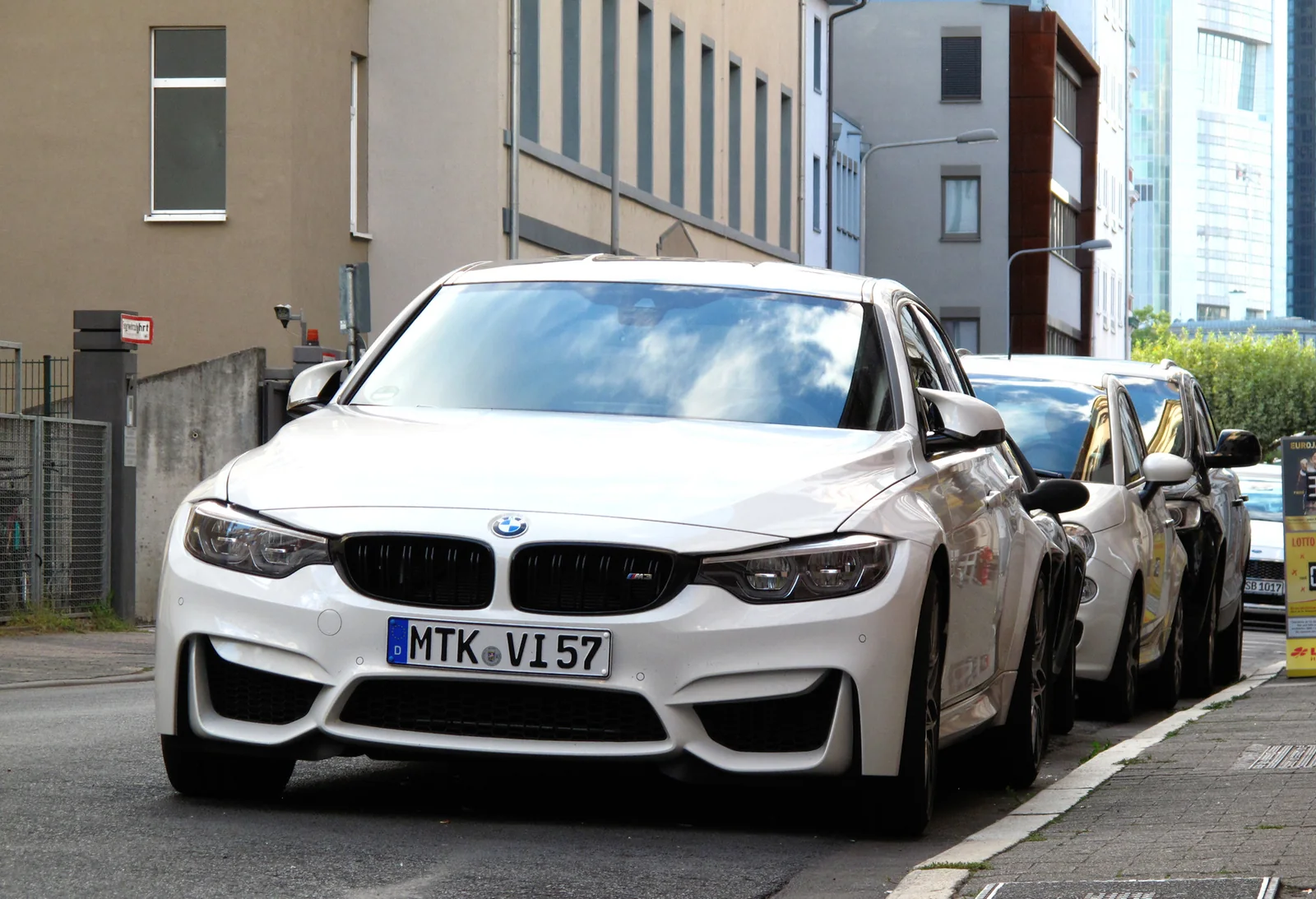
BMW F80 M3
UK MOT + US NHTSA · Reviewed · MethodologyUK roadworthiness data and US recall records · Great Britain MOT 2023; US NHTSA full-file snapshot 2026-10-29; UK DfT stock 2025 · Reviewed by Responsable del proyecto (usuario de esta conversación; nombre personal no facilitado) on 2026-10-29 · Sources and methodology
At a glance
- First-presentation pass rate
- 88.1%n = 3,431 initial tests
- Initial tests
- 3,431UK MOT 2023
- Engine
- S55 · 3.0L turbo inline-sixTechnical source in the engine section
- Years
- US launch: MY2015Production and US model years can differ
- DVSA anonymised MOT tests and results · Retrieved 2026-10-29T05:26:14Z · Open Government Licence v3.0 · BMW M3; cc=2979-2979; first_use_year=2014-2019; provisional cohort, not VIN verified; ambiguous F10/F90 2017 excluded
The F80 returns the M3 to an inline-six and adds turbocharging. It is the sedan in the M3/M4 split, so coupe information should not silently become F80 evidence. This guide explains the verified US launch specification and Competition Package, identifies two narrow campaign topics and keeps the crank-hub question unresolved where primary evidence is missing. Our comparison is based on published documents. Initial human editorial review is complete; Any vehicle assessment remains outside this project.
Is the F80 M3 reliable?
No data: the official sources consulted do not establish a comprehensive F80 failure rate, a lifetime repair budget or a comparison between modified and standard cars. A specific safety campaign is useful evidence about its defined issue; it cannot be stretched into a judgment about every S55 engine.
For a particular example, establish what the car is before judging its record. Ask which parts and software are fitted, what has changed and whether the documentation describes those changes. Treat an unclear modification history as an unresolved inspection question. The provisional editorial conclusion is straightforward: the F80's documented appeal is a turbocharged sedan layout; its suitability as an individual used car depends on evidence not available from the model name.
- BMW USA: The All-New BMW M3 Sedan and BMW M4 Coupe · Retrieved 2026-10-28 · BMW copyrighted press material; facts paraphrased, no images or paragraphs copied. · US launch specification only. Press claims about driving quality are not adopted as independently tested facts.
- NHTSA: Resources Related to Investigations and Recalls · Retrieved 2026-10-28 · NHTSA US government webpage; factual paraphrase. · Complaints do not provide a fleet exposure denominator or a measured failure probability.
Documented campaign topics and unresolved engine claims
These are distinct issues with distinct evidence. A production window for one campaign does not establish that vehicles outside it are free from unrelated problems.
S55 crank-hub question
No data: an official primary document establishing the frequency, affected population or a preventive replacement rule for an S55 crank-hub failure was not located for this guide. We do not claim every engine is affected, that a particular mileage is a safe boundary, or that an aftermarket intervention is required.
Ask an inspector to evaluate the actual car and explain any relevant diagnosis or previous work. If a modification is advertised as a fix, request its exact specification, installer record and supporting evidence. A component's presence is not proof of a measured reduction in risk.
- BMW USA: 2015 BMW M3 Sedan Technical Data · Retrieved 2026-10-28 · BMW copyrighted specification sheet; limited factual reference. · Configuration-dependent figures must not be generalized to every edition.
Driveshaft universal-joint campaign
BMW bulletin 15V-782 covers a narrow F80/M4 production population from May 30 through October 11, 2015. It identifies missing grease at the driveshaft's rear universal joint as the campaign concern. This supports a campaign-history check for relevant cars, not a claim that the entire F80 generation has the same defect.
- BMW SI B26 01 15: Recall 15V-782, driveshaft universal joint · Retrieved 2026-10-28 · BMW service bulletin hosted by NHTSA; short factual paraphrase only. · Narrow production population; no generation-wide prevalence or repair instruction is inferred.
Rear sub-frame bolt campaign
A BMW recall-notification summary includes F80 M3 vehicles in campaign 16V-653 for rear sub-frame bolts. No data: that summary alone does not establish a car's VIN applicability, a current symptom or a generation-wide failure frequency. Ask BMW to confirm the exact campaign status for the vehicle.
- BMW SI B08 04 16: Recall campaign customer notification · Retrieved 2026-10-28 · BMW manufacturer communication hosted by NHTSA; factual paraphrase only. · Notification summary, not detailed diagnosis or evidence that every F80 is affected.
Other repeated reliability claims
No data: this guide has no accepted primary defect evidence from which to rank turbocharger, cooling-system or transmission failures across all F80 cars. These systems can still be included in an inspector's agreed assessment. The distinction is between asking a useful question and claiming a verified common defect.
- BMW USA: The All-New BMW M3 Sedan and BMW M4 Coupe · Retrieved 2026-10-28 · BMW copyrighted press material; facts paraphrased, no images or paragraphs copied. · US launch specification only. Press claims about driving quality are not adopted as independently tested facts.
- BMW SI B26 01 15: Recall 15V-782, driveshaft universal joint · Retrieved 2026-10-28 · BMW service bulletin hosted by NHTSA; short factual paraphrase only. · Narrow production population; no generation-wide prevalence or repair instruction is inferred.
- BMW SI B08 04 16: Recall campaign customer notification · Retrieved 2026-10-28 · BMW manufacturer communication hosted by NHTSA; factual paraphrase only. · Notification summary, not detailed diagnosis or evidence that every F80 is affected.
What to check before buying
Keep the assessment specific to the sedan, its actual equipment and its history. A car can match the published power specification and still have unresolved inspection findings. Equally, the absence of a campaign entry is not a complete health check.
- Confirm the build information, transmission and whether a claimed Competition Package is documented.
- Request an account of hardware and software changes, supported by dated records.
- Check relevant VIN campaigns, including any applicable driveshaft or rear-bolt work, and preserve completion evidence.
- Have a qualified inspector explain stored faults, warning messages, leaks and the condition of the fitted systems.
- Ask the inspector to separate observed problems, work recommended for a stated reason and items they could not assess.
- BMW USA: New Competition Package Amps Up the BMW M3 and M4 · Retrieved 2026-10-28 · BMW copyrighted press material; factual paraphrase only. · Package specification does not prove a car has the factory package or establish a reliability improvement.
- BMW SI B26 01 15: Recall 15V-782, driveshaft universal joint · Retrieved 2026-10-28 · BMW service bulletin hosted by NHTSA; short factual paraphrase only. · Narrow production population; no generation-wide prevalence or repair instruction is inferred.
- BMW SI B08 04 16: Recall campaign customer notification · Retrieved 2026-10-28 · BMW manufacturer communication hosted by NHTSA; factual paraphrase only. · Notification summary, not detailed diagnosis or evidence that every F80 is affected.
US launch and Competition Package changes
BMW introduced the US M3 sedan as a 2015 model, with sales beginning in summer 2014. Its spring-2016 Competition Package announcement raises output to 444 hp and describes revisions to suspension, differential and stability-control settings. The package should be identified from the car's build documentation, rather than inferred from appearance.
No data: a full annual US change table, CS specification audit and individual option compatibility record are not included in this guide. They require separate primary verification before being used to distinguish two specific vehicles.
| US reference | Verified distinction |
|---|---|
| 2015 launch model | M3 sedan; 425-hp US launch rating |
| Competition Package from spring 2016 | 444-hp rating and chassis/control revisions |
- BMW USA: The All-New BMW M3 Sedan and BMW M4 Coupe · Retrieved 2026-10-28 · BMW copyrighted press material; facts paraphrased, no images or paragraphs copied. · US launch specification only. Press claims about driving quality are not adopted as independently tested facts.
- BMW USA: New Competition Package Amps Up the BMW M3 and M4 · Retrieved 2026-10-28 · BMW copyrighted press material; factual paraphrase only. · Package specification does not prove a car has the factory package or establish a reliability improvement.
Engine: S55
BMW's US technical sheet names the S55B30T0. The launch material rates the turbocharged 3.0-liter inline-six at 425 hp and 406 lb-ft, paired with a six-speed manual or optional seven-speed M DCT. Those baseline figures should not be substituted for every later edition or a modified example.
The comparison with the V8 M3 is about architecture and rated output before it is about preference. A broader torque band in a launch specification does not demonstrate better long-term durability. Nor does the naturally aspirated label on the previous car demonstrate lower repair exposure.
- BMW USA: 2015 BMW M3 Sedan Technical Data · Retrieved 2026-10-28 · BMW copyrighted specification sheet; limited factual reference. · Configuration-dependent figures must not be generalized to every edition.
- BMW USA: The All-New BMW M3 Sedan and BMW M4 Coupe · Retrieved 2026-10-28 · BMW copyrighted press material; facts paraphrased, no images or paragraphs copied. · US launch specification only. Press claims about driving quality are not adopted as independently tested facts.
NHTSA recalls and exact applicability
Use the VIN rather than applying every M3, M4 or regular 3 Series campaign to this car. The historical panel and the problem notes identify evidence to investigate; they do not report whether your vehicle has completed a repair.
| Complaint coverage | Recall coverage | Queried model years | Owner reports | Unique campaigns | Vehicle denominator |
|---|---|---|---|---|---|
| Complete for requested model-year scope | Complete for requested model-year scope | 2015;2016;2017;2018 | 21 | 4 | No data |
No data means the stated scope is unavailable, incomplete or has no vehicle denominator; it never means zero. Report totals and details are shown only for complete requested coverage for the respective dataset. Counts are not vehicle-level failure probabilities.
- NHTSA official datasets and APIs · Retrieved 2026-10-29 · US federal government public data; NHTSA
| Campaign | Queried model years | Report date | Component | Summary |
|---|---|---|---|---|
| 15V782000 | 2015;2016 | 20151123 | POWER TRAIN:DRIVELINE:DRIVESHAFT | BMW of North America, LLC (BMW) is recalling certain model year 2015-2016 M3 Sedan vehicles manufactured May 30, 2015, to September 2, 2015, 2016 M4 Coupe vehicles manufactured July 3, 2015, to September 11, 2015, and 2015-2016 M4 Convertible vehicles manufactured May 29, 2015, to August 4, 2015. The affected vehicles have a driveshaft with a slip-joint that may not have been filled with grease. As a result, the slip-joint may fail over time. |
| 16V653000 | 2015;2016;2017 | 20160909 | STRUCTURE:FRAME AND MEMBERS | BMW North America, LLC (BMW) is recalling certain model year 2016 BMW M2 Coupe vehicles, 2015-2017 M3 Sedan vehicles and 2015-2016 M4 Coupe and M4 Convertible vehicles. During servicing of the rear differential for a prior service action, the rear sub-frame bolts may have been reused instead of being replaced. Reuse of the existing bolts may cause the bolts to loosen. |
| 18V713000 | 2016;2017 | 20181011 | POWER TRAIN:DRIVELINE:DRIVESHAFT | BMW of North America, LLC (BMW) is recalling certain 2016-2017 BMW M3 Sedans, 2016-2017 BMW M4 and M4 GTS Coupes and 2017 BMW M4 Convertible vehicles. The connection between the driveshaft and the flange may fail resulting in a loss of propulsion. |
| 24V288000 | 2015 | 20240424 | AIR BAGS:SIDE/WINDOW | BMW of North America, LLC (BMW) is recalling certain 2014-2015 2 Series Coupe (228i, 228i xDrive, M235i), 3 Series Sedan (320i, 320i xDrive, 328i, 328i xDrive, 335i, 335i xDrive, M3, 328d, 328d xDrive), 4 Series Coupe (428i, 428i xDrive, 435i, 435i xDrive, M4), and 2015 4 Series Gran Coupe (428i, 428i xDrive, 435i, 435i xDrive) vehicles. The head air bag inflator may fail at the weld joint, which can cause gas to leak from the inflator or result in an inflator rupture. |
Campaign records may overlap model years and other BMW models. A listed campaign does not establish whether a particular VIN remains unrepaired.
- NHTSA recalls; check an individual vehicle by VIN · Retrieved 2026-10-29 · US federal government public data; NHTSA
| Component | Reports mentioning component | Reports in query | Queried model years |
|---|---|---|---|
| FUEL/PROPULSION SYSTEM | 8 | 21 | 2015;2016;2017;2018 |
| ENGINE | 6 | 21 | 2015;2016;2017;2018 |
| UNKNOWN OR OTHER | 4 | 21 | 2015;2016;2017;2018 |
| ELECTRICAL SYSTEM | 2 | 21 | 2015;2016;2017;2018 |
| POWER TRAIN | 2 | 21 | 2015;2016;2017;2018 |
| FUEL SYSTEM, GASOLINE | 1 | 21 | 2015;2016;2017;2018 |
| POWER TRAIN:DRIVELINE:DRIVESHAFT | 1 | 21 | 2015;2016;2017;2018 |
| STRUCTURE:BODY | 1 | 21 | 2015;2016;2017;2018 |
| SUSPENSION | 1 | 21 | 2015;2016;2017;2018 |
Owner reports are allegations and may mention several components. No fleet denominator is available: these counts are not failure rates or proof of a defect.
- NHTSA complaints dataset · Retrieved 2026-10-29 · US federal government public data; NHTSA
- NHTSA: Check for Recalls · Retrieved 2026-10-28 · NHTSA US government webpage; factual paraphrase. · Dynamic service; no live VIN query was performed.
- NHTSA VIN recall lookup
Interpreting the British MOT sample
The displayed results concern tests in Great Britain. The sample is neither a census of US F80s nor an S55 engine-life study. Read the result coding and time period, and avoid treating rectification at the test station as an initial pass. Unverified odometer units remain unknown.
| Test year | Initial tests | P: first pass | F: failed | PRS: rectified | First-presentation pass (%) | Final pass (%) |
|---|---|---|---|---|---|---|
| 2023 | 3,431 | 3021 | 351 | 59 | 88.1% | 89.8 |
P passed at first presentation; F failed; PRS failed initially and passed after rectification. First-presentation pass rate = P / (P + F + PRS); final pass rate = (P + PRS) / (P + F + PRS). UK roadworthiness tests cover safety and emissions; they do not measure engine life, gearbox health, service history or US failure probability. Contains public sector information licensed under the Open Government Licence v3.0.
- DVSA anonymised MOT tests and results · Retrieved 2026-10-29T05:26:14Z · Open Government Licence v3.0 · BMW M3; cc=2979-2979; first_use_year=2014-2019; provisional cohort, not VIN verified; ambiguous F10/F90 2017 excluded
- Open Government Licence v3.0
| Record kind | MOT area code | Annotations | Distinct tests | Tests per 100 initial tests |
|---|---|---|---|---|
| advisory | Body, chassis, structure | 8 | 8 | 0.2 |
| advisory | Brakes | 310 | 189 | 5.5 |
| advisory | Identification of the vehicle | 8 | 8 | 0.2 |
| advisory | Lamps, reflectors and electrical equipment | 2 | 1 | 0.0 |
| advisory | Noise, emissions and leaks | 56 | 53 | 1.5 |
| advisory | Non-component advisories | 145 | 122 | 3.6 |
| advisory | Road Wheels | 9 | 8 | 0.2 |
| advisory | Seat belts and supplementary restraint systems | 3 | 3 | 0.1 |
| advisory | Steering | 1 | 1 | 0.0 |
| advisory | Suspension | 56 | 46 | 1.3 |
| advisory | Tyres | 792 | 440 | 12.8 |
| advisory | Visibility | 1 | 1 | 0.0 |
| defect | Body, chassis, structure | 3 | 3 | 0.1 |
| defect | Brakes | 37 | 28 | 0.8 |
| defect | Identification of the vehicle | 35 | 24 | 0.7 |
| defect | Lamps, reflectors and electrical equipment | 29 | 23 | 0.7 |
| defect | Noise, emissions and leaks | 49 | 31 | 0.9 |
| defect | Road Wheels | 13 | 8 | 0.2 |
| defect | Seat belts and supplementary restraint systems | 8 | 8 | 0.2 |
| defect | Steering | 5 | 4 | 0.1 |
| defect | Suspension | 134 | 112 | 3.3 |
| defect | Tyres | 290 | 178 | 5.2 |
| defect | Visibility | 22 | 21 | 0.6 |
| minor | Body, chassis, structure | 4 | 3 | 0.1 |
| minor | Brakes | 3 | 2 | 0.1 |
| minor | Lamps, reflectors and electrical equipment | 7 | 6 | 0.2 |
| minor | Steering | 5 | 5 | 0.1 |
| minor | Suspension | 5 | 4 | 0.1 |
| minor | Tyres | 2 | 2 | 0.1 |
| minor | Visibility | 59 | 56 | 1.6 |
| rectified_defect | Body, chassis, structure | 2 | 2 | 0.1 |
| rectified_defect | Brakes | 2 | 1 | 0.0 |
| rectified_defect | Identification of the vehicle | 10 | 8 | 0.2 |
| rectified_defect | Lamps, reflectors and electrical equipment | 43 | 33 | 1.0 |
| rectified_defect | Noise, emissions and leaks | 5 | 5 | 0.1 |
| rectified_defect | Road Wheels | 6 | 3 | 0.1 |
| rectified_defect | Seat belts and supplementary restraint systems | 3 | 3 | 0.1 |
| rectified_defect | Tyres | 10 | 8 | 0.2 |
| rectified_defect | Visibility | 7 | 7 | 0.2 |
Area codes follow the DVSA source. The percentage counts distinct tests within each area; one test can appear in several areas. Do not add percentages across areas. Defect, rectified-defect, minor and advisory records are separate.
- DVSA anonymised MOT tests and results · Retrieved 2026-10-29T05:26:14Z · Open Government Licence v3.0 · BMW M3; cc=2979-2979; first_use_year=2014-2019; provisional cohort, not VIN verified; ambiguous F10/F90 2017 excluded
| Item | Inspection area | Distinct initial tests | Tests per 100 initial tests | Source record code |
|---|---|---|---|---|
| A tyre cords visible or damaged | Tyres | 96 | 2.8 | F |
| A spring or spring component fractured or seriously weakened | Suspension | 77 | 2.2 | F |
| A tyre seriously damaged | Tyres | 49 | 1.4 | F |
| Tyre tread depth not in accordance with the requirements | Tyres | 29 | 0.8 | F |
| A suspension pin, bush or joint excessively worn | Suspension | 25 | 0.7 | F |
| Number plate does not conform to the specified requirements | Identification of the vehicle | 20 | 0.6 | F |
| A tyre seriously damaged | Tyres | 12 | 0.3 | F |
| Windscreen washers not working or not providing sufficient fluid to clear the windscreen | Visibility | 12 | 0.3 | F |
| Lambda coefficient outside the default limits or the range specified by the manufacturer | Noise, emissions and leaks | 10 | 0.3 | F |
| Emissions levels exceed default limits | Noise, emissions and leaks | 7 | 0.2 | F |
| A direction indicator lamp missing, inoperative or in the case of a multiple light source more than 1/2 not functioning | Lamps, reflectors and electrical equipment | 6 | 0.2 | F |
| Engine MIL illuminated indicating a malfunction | Noise, emissions and leaks | 6 | 0.2 | F |
| A wheel with a loose or missing wheel nut, bolt or stud | Road Wheels | 6 | 0.2 | F |
| A tyre cords visible or damaged | Tyres | 6 | 0.2 | F |
| A tyre pressure monitoring system malfunctioning or obviously inoperative | Tyres | 6 | 0.2 | F |
| Wiper blade missing or obviously not clearing the windscreen | Visibility | 6 | 0.2 | F |
| Excessive fluctuation in brake effort through each wheel revolution. | Brakes | 5 | 0.1 | F |
| Emissions levels exceed default limits | Noise, emissions and leaks | 5 | 0.1 | F |
| Emissions levels exceed the manufacturer's specified limits | Noise, emissions and leaks | 5 | 0.1 | F |
| A tyre seriously damaged | Tyres | 5 | 0.1 | F |
| A headlamp cleaning device inoperative in the case of LED or gas discharge systems (HID) | Lamps, reflectors and electrical equipment | 4 | 0.1 | F |
| Emission control equipment fitted by the manufacturer missing, obviously modified or obviously defective | Noise, emissions and leaks | 4 | 0.1 | F |
| Emissions test unable to be completed | Noise, emissions and leaks | 4 | 0.1 | F |
| ESC MIL indicates a system malfunction | Brakes | 3 | 0.1 | F |
| Parking brake efficiency less than 50% of the required value | Brakes | 3 | 0.1 | F |
Ranked by distinct initial tests mentioning each item, within this record kind only. Do not add item percentages or record kinds: a test can mention several items. F/P source records remain separate. Catalogue deficiency categories are not observed severity and are not displayed. Advisory and minor records are not counted as failed tests.
- DVSA anonymised MOT tests and results · Retrieved 2026-10-29T05:26:14Z · Open Government Licence v3.0 · BMW M3; cc=2979-2979; first_use_year=2014-2019; provisional cohort, not VIN verified; ambiguous F10/F90 2017 excluded
- Open Government Licence v3.0
| Item | Inspection area | Distinct initial tests | Tests per 100 initial tests | Source record code |
|---|---|---|---|---|
| The aim of a headlamp is not within limits laid down in the requirements | Lamps, reflectors and electrical equipment | 14 | 0.4 | P |
| The aim of a headlamp is not within limits laid down in the requirements | Lamps, reflectors and electrical equipment | 13 | 0.4 | P |
| Number plate does not conform to the specified requirements | Identification of the vehicle | 5 | 0.1 | P |
| Engine MIL illuminated indicating a malfunction | Noise, emissions and leaks | 5 | 0.1 | P |
| Windscreen washers not working or not providing sufficient fluid to clear the windscreen | Visibility | 4 | 0.1 | P |
| A wheel with a loose or missing wheel nut, bolt or stud | Road Wheels | 3 | 0.1 | P |
| Number plate missing or so insecure that it is likely to fall off | Identification of the vehicle | 2 | 0.1 | P |
| Stop lamp missing, inoperative or in the case of a multiple light source more than 1/2 not functioning | Lamps, reflectors and electrical equipment | 2 | 0.1 | P |
| A tyre cords visible or damaged | Tyres | 2 | 0.1 | P |
| A tyre pressure monitoring system malfunctioning or obviously inoperative | Tyres | 2 | 0.1 | P |
| A tyre seriously damaged | Tyres | 2 | 0.1 | P |
| Windscreen washers not working or not providing sufficient fluid to clear the windscreen | Visibility | 2 | 0.1 | P |
| A body panel or body component likely to become detached | Body, chassis, structure | 1 | 0.0 | P |
| Bumper insecure or with damage likely to cause injury when grazed or contacted | Body, chassis, structure | 1 | 0.0 | P |
| A brake on any wheel grabbing severely | Brakes | 1 | 0.0 | P |
| Number plate showing an incorrect registration | Identification of the vehicle | 1 | 0.0 | P |
| A headlamp cleaning device inoperative in the case of LED or gas discharge systems (HID) | Lamps, reflectors and electrical equipment | 1 | 0.0 | P |
| A lamp missing, inoperative or in the case of a multiple light source more than 1/2 not functioning | Lamps, reflectors and electrical equipment | 1 | 0.0 | P |
| Audible warning inoperative | Lamps, reflectors and electrical equipment | 1 | 0.0 | P |
| The aim of a headlamp is not within limits laid down in the requirements | Lamps, reflectors and electrical equipment | 1 | 0.0 | P |
| The aim of a headlamp is not within limits laid down in the requirements | Lamps, reflectors and electrical equipment | 1 | 0.0 | P |
| The aim of a headlamp is not within limits laid down in the requirements | Lamps, reflectors and electrical equipment | 1 | 0.0 | P |
| A statutory seat belt missing | Seat belts and supplementary restraint systems | 1 | 0.0 | P |
| Seat belt buckle missing, damaged or not functioning as intended | Seat belts and supplementary restraint systems | 1 | 0.0 | P |
| Seat belt buckle missing, damaged or not functioning as intended | Seat belts and supplementary restraint systems | 1 | 0.0 | P |
Ranked by distinct initial tests mentioning each item, within this record kind only. Do not add item percentages or record kinds: a test can mention several items. F/P source records remain separate. Catalogue deficiency categories are not observed severity and are not displayed. Advisory and minor records are not counted as failed tests.
- DVSA anonymised MOT tests and results · Retrieved 2026-10-29T05:26:14Z · Open Government Licence v3.0 · BMW M3; cc=2979-2979; first_use_year=2014-2019; provisional cohort, not VIN verified; ambiguous F10/F90 2017 excluded
- Open Government Licence v3.0
| Item | Inspection area | Distinct initial tests | Tests per 100 initial tests | Source record code |
|---|---|---|---|---|
| worn close to legal limit/worn on edge | Tyres | 289 | 8.4 | A |
| worn, pitted or scored, but not seriously weakened | Brakes | 132 | 3.8 | A |
| slightly damaged/cracking or perishing | Tyres | 72 | 2.1 | A |
| Nail in tyre | Non-component advisories | 65 | 1.9 | A |
| worn close to legal limit/worn on edge | Tyres | 56 | 1.6 | A |
| Child Seat fitted not allowing full inspection of adult belt | Non-component advisories | 53 | 1.5 | A |
| has a cut but not deep enough to reach the ply or cords | Tyres | 45 | 1.3 | A |
| wearing thin | Brakes | 39 | 1.1 | A |
| leak, but not excessive | Noise, emissions and leaks | 28 | 0.8 | A |
| leak, but not excessive | Noise, emissions and leaks | 23 | 0.7 | A |
| worn, but not excessively | Brakes | 21 | 0.6 | A |
| slightly damaged | Tyres | 20 | 0.6 | A |
| ball joint has slight play | Suspension | 19 | 0.6 | A |
| corroded | Suspension | 15 | 0.4 | A |
| fluctuating, but not excessively | Brakes | 11 | 0.3 | A |
| slightly distorted | Road Wheels | 8 | 0.2 | A |
| Items removed from driver's view prior to test | Non-component advisories | 7 | 0.2 | A |
| has a minor leak of exhaust gases | Body, chassis, structure | 6 | 0.2 | A |
| deteriorated but not likely to be misread | Identification of the vehicle | 6 | 0.2 | A |
| has light misting of oil | Suspension | 4 | 0.1 | A |
| binding but not excessively | Brakes | 3 | 0.1 | A |
| leak, but not excessive | Noise, emissions and leaks | 3 | 0.1 | A |
| has slight play | Suspension | 3 | 0.1 | A |
| pin or bush worn but not resulting in excessive movement | Suspension | 3 | 0.1 | A |
| noisy | Body, chassis, structure | 2 | 0.1 | A |
Ranked by distinct initial tests mentioning each item, within this record kind only. Do not add item percentages or record kinds: a test can mention several items. F/P source records remain separate. Catalogue deficiency categories are not observed severity and are not displayed. Advisory and minor records are not counted as failed tests.
- DVSA anonymised MOT tests and results · Retrieved 2026-10-29T05:26:14Z · Open Government Licence v3.0 · BMW M3; cc=2979-2979; first_use_year=2014-2019; provisional cohort, not VIN verified; ambiguous F10/F90 2017 excluded
- Open Government Licence v3.0
| Item | Inspection area | Distinct initial tests | Tests per 100 initial tests | Source record code |
|---|---|---|---|---|
| Windscreen or window damaged or seriously discoloured but not adversely affecting driver's view | Visibility | 50 | 1.5 | M |
| A lamp with a multiple light source up to 1/2 not functioning | Lamps, reflectors and electrical equipment | 4 | 0.1 | M |
| Steering rack gaiter or ball joint dust cover damaged or deteriorated | Steering | 4 | 0.1 | M |
| Wiper blade defective | Visibility | 4 | 0.1 | M |
| A suspension joint dust cover severely deteriorated | Suspension | 3 | 0.1 | M |
| A transmission shaft constant velocity joint boot severely deteriorated | Body, chassis, structure | 2 | 0.1 | M |
| Brake pipe inadequately clipped or supported | Brakes | 2 | 0.1 | M |
| Tyre obviously under inflated | Tyres | 2 | 0.1 | M |
| Windscreen or window excessively tinted but not adversely affecting driver's view | Visibility | 2 | 0.1 | M |
| A door hinge, catch or pillar excessively deteriorated | Body, chassis, structure | 1 | 0.0 | M |
| A direction indicator lamp with a multiple light source up to 1/2 not functioning | Lamps, reflectors and electrical equipment | 1 | 0.0 | M |
| A lamp not securely attached | Lamps, reflectors and electrical equipment | 1 | 0.0 | M |
| A lens defective which has no effect on emitted light | Lamps, reflectors and electrical equipment | 1 | 0.0 | M |
| Steering rack gaiter or ball joint dust cover damaged or deteriorated | Steering | 1 | 0.0 | M |
| A suspension joint dust cover severely deteriorated | Suspension | 1 | 0.0 | M |
Ranked by distinct initial tests mentioning each item, within this record kind only. Do not add item percentages or record kinds: a test can mention several items. F/P source records remain separate. Catalogue deficiency categories are not observed severity and are not displayed. Advisory and minor records are not counted as failed tests.
- DVSA anonymised MOT tests and results · Retrieved 2026-10-29T05:26:14Z · Open Government Licence v3.0 · BMW M3; cc=2979-2979; first_use_year=2014-2019; provisional cohort, not VIN verified; ambiguous F10/F90 2017 excluded
- Open Government Licence v3.0
- GOV.UK / DVSA: Getting an MOT · Retrieved 2026-10-28 · Open Government Licence v3.0 except where stated; attribution to GOV.UK / DVSA. · Not a US inspection survey or a forecast of engine/transmission durability.
Production and registration counts
No data: an accepted F80 total with consistent market, edition and production-date scope is not included. Registration statistics, when separately shown, are not a substitute for worldwide production or a count of cars still operating in the United States.
| Period | Manufacture cohort | Licensed | SORN | Coverage | Coverage reason | Source limitations |
|---|---|---|---|---|---|---|
| 2025 | No data | No data | No data | No data | No documented global manufacture interval accepted for this generation; US model-year launch evidence does not establish a UK manufacture mapping. | United Kingdom end-of-year stock in DfT VEH0124, not worldwide or US survivors. Approximate partial cohort by recorded model label and YearManufacture; not VIN-verified. Boundary years and unknown manufacture years excluded. Imports, exports, scrappage and registration/coding changes affect stock; no production denominator or survival percentage. Non-numeric source cells stay unknown; absent rows are not zero. |
UK registrations are not worldwide production totals. A manufacture cohort covers only the listed manufacture years; partial cohorts must not be read as a whole-generation total. A generation total is shown only when the supplied mapping supports it.
- DfT vehicle licensing statistics · United Kingdom end-of-year stock in DfT VEH0124, not worldwide or US survivors. Approximate partial cohort by recorded model label and YearManufacture; not VIN-verified. Boundary years and unknown manufacture years excluded. Imports, exports, scrappage and registration/coding changes affect stock; no production denominator or survival percentage. Non-numeric source cells stay unknown; absent rows are not zero.
Sedan, Competition Package and CS
The F80 page covers the M3 sedan. The corresponding coupe belongs to the M4 family, while the documented Competition Package remains a section here. No data: the CS is not assigned a separate specification or reliability conclusion until its primary documents are reviewed.
- BMW USA: The All-New BMW M3 Sedan and BMW M4 Coupe · Retrieved 2026-10-28 · BMW copyrighted press material; facts paraphrased, no images or paragraphs copied. · US launch specification only. Press claims about driving quality are not adopted as independently tested facts.
- BMW USA: New Competition Package Amps Up the BMW M3 and M4 · Retrieved 2026-10-28 · BMW copyrighted press material; factual paraphrase only. · Package specification does not prove a car has the factory package or establish a reliability improvement.
Continue exploring
BMW M3 E46 (2000–2006): Reliability, Common Problems and Recalls
A US-focused E46 M3 guide to the S54, manual and SMG II, documented safety issues, inspection questions and the limits of reliability data.
BMW E92 M3 and the shared E90/E92/E93 generation
US-focused E92 M3 guide covering the shared E90/E92/E93 generation: V8 specifications, body styles, DCT recall context, inspection questions and data limits.
Read the evidence in context
The MOT is a UK roadworthiness inspection. Its pass rate is not an engine-reliability score and does not predict a US owner's repair costs. Recall applicability must be checked by VIN. Read the methodology and limitations.